High blood pressure affects nearly half of all adults in the United States, and the percentage climbs with age. Among adults over 65, roughly two-thirds have hypertension. It is called the “silent killer” for good reason: it typically has no symptoms until it causes a stroke, heart attack, or kidney damage.
Office blood pressure readings, the ones taken at the doctor’s appointment, are notoriously unreliable for two reasons. First, many people experience “white coat hypertension,” where anxiety about the medical setting causes artificially high readings. Second, a single reading captures only one moment in time. Blood pressure fluctuates throughout the day based on activity, stress, food, and medication timing.
Home monitoring solves both problems. Regular readings in a calm, familiar environment provide a much more accurate picture of actual blood pressure. And when those readings sync automatically to a phone app, sharing them with a doctor becomes effortless.
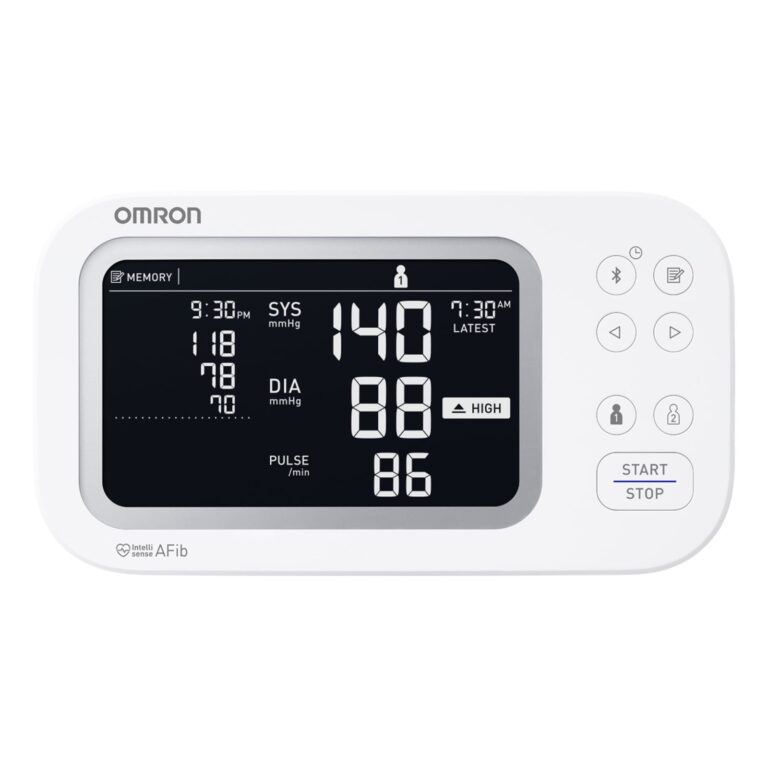
Omron Platinum BP5450
Triple-read averaging for clinical-grade accuracy at home
Check Price on AmazonWhy Home Monitoring Is Now the Clinical Standard
The American Heart Association, the American College of Cardiology, and most major cardiology guidelines now recommend home blood pressure monitoring as the standard for managing hypertension. This is not an alternative or supplement to office monitoring. It is the primary method.
The reasons are practical:
- Better data: A week of home readings (morning and evening) gives the doctor 14 data points instead of one. Patterns emerge. Maybe blood pressure is well-controlled in the morning but spikes in the evening. Maybe the Saturday reading is always high because of a stressful routine. This level of detail allows much more precise medication adjustment.
- Medication adjustment: When a doctor changes a blood pressure medication, they need to see the effect over days and weeks, not just at the next office visit three months later. Home monitoring provides that real-time feedback.
- Detecting masked hypertension: Some people have normal readings at the doctor but high readings at home. This “masked hypertension” is just as dangerous as the reverse, and only home monitoring catches it.
Choosing the Right Monitor: Upper Arm Only
This is important: only use an upper arm cuff monitor for home blood pressure measurement. Wrist monitors and finger monitors are widely available and heavily marketed, but they are significantly less accurate. The American Heart Association specifically recommends upper arm monitors for home use.
Wrist monitors are sensitive to arm position. The wrist must be held exactly at heart level for an accurate reading. Even a few inches too high or too low changes the result meaningfully. For a senior managing this independently, getting the position right every time is unrealistic.
The Omron Platinum (BP5450) is the monitor most frequently recommended by cardiologists for home use. Here is what makes it well-suited for seniors and caregivers:
- TruRead technology: It takes three consecutive readings automatically (one minute apart) and displays the average. This addresses the common problem of a high first reading caused by the discomfort or novelty of the cuff inflating. The average of three readings is significantly more accurate than a single measurement.
- Multi-user storage: Stores readings for two users with unlimited memory. If both parents use it, each person’s readings are tracked separately.
- Bluetooth sync: Readings automatically transfer to the Omron Connect app on a paired smartphone. The app stores the complete history and can generate PDF reports formatted for doctor visits.
- Irregular heartbeat detection: The monitor flags readings where an irregular heartbeat was detected. This is not a diagnostic tool, but it can prompt a conversation with the doctor about screening for atrial fibrillation.
- Large, backlit display: The numbers are easy to read, even for someone with vision issues.
How to Take an Accurate Reading
Proper technique matters more than the quality of the monitor. An expensive monitor used incorrectly gives worse data than a cheap monitor used correctly. Here is the protocol recommended by the American Heart Association:
Preparation (5 minutes before)
- Sit quietly for 5 minutes before taking a reading. No talking, no phone, no TV.
- Empty the bladder first. A full bladder raises blood pressure.
- Avoid caffeine, exercise, and smoking for 30 minutes prior.
- Sit in a chair with feet flat on the floor and back supported. Do not sit on the edge of the bed or an exam table.
Cuff Placement
- Place the cuff on bare skin (not over clothing) on the upper left arm.
- The bottom edge of the cuff should be about one inch above the elbow crease.
- The cuff tubing should align with the brachial artery (the inside center of the arm).
- The cuff should be snug but not tight. You should be able to slide one finger underneath.
During the Reading
- Rest the arm on a table or armrest so the cuff is at heart level. This is critical. An unsupported arm hanging at the side can add 10 points to the reading.
- Do not talk or move during the measurement.
- If using the Omron Platinum’s TruRead feature, stay still for all three readings (about 3-4 minutes total).
Recording
- If the monitor syncs to an app, the reading is recorded automatically.
- If recording manually, note the systolic (top number), diastolic (bottom number), and pulse.
- Take readings at the same times each day for consistency. Morning (before medications) and evening are the most useful times.
Understanding the Numbers
Blood pressure is expressed as two numbers: systolic (pressure when the heart beats) over diastolic (pressure between beats). Here is what the ranges mean for home readings, which run slightly lower than office readings:
- Normal: Below 120/80
- Elevated: 120-129 / below 80
- High (Stage 1): 130-139 / 80-89
- High (Stage 2): 140+ / 90+
- Crisis (seek immediate medical attention): Above 180/120
A single high reading is not cause for alarm. Blood pressure naturally varies throughout the day. What matters is the trend over days and weeks. If most morning readings are in the 130s and most evening readings are in the 140s, that is the pattern the doctor needs to see.
Sharing Data with the Doctor
The Omron Connect app makes this straightforward. Before a doctor’s appointment:
- Open the app and select the date range you want to share (typically the last 2-4 weeks).
- Generate a PDF report. The app formats the data as a clean chart showing readings over time, averages, and any flagged irregular heartbeats.
- Email the PDF to the doctor’s office or print it to bring to the appointment.
This is dramatically better than a handwritten notebook or trying to remember numbers. Doctors can immediately see trends, identify medication effects, and make informed adjustments. Many cardiologists say that home monitoring data is more valuable to them than their own office measurements.
Remote Monitoring for Caregivers
If you are managing a parent’s health remotely, the Omron Connect app can be installed on your phone as well. When your parent takes a reading, it syncs to their phone, and you can access the data through a shared account or by having them forward the readings.
Some practical approaches:
- Daily text: Ask your parent (or their caregiver) to screenshot the reading and text it to you each morning.
- Weekly review: Check the app once a week and look for any readings above or below the target range their doctor has set.
- Pre-appointment prep: Generate the PDF report for your parent before their doctor visit so they do not have to manage the technology themselves.
Frequently Asked Questions
How often should my parent check their blood pressure?
For someone with diagnosed hypertension on medication, twice daily (morning before meds and evening) is the standard recommendation. Once the medication is stable and readings are consistently in range, many doctors reduce this to a few times per week. Ask their specific doctor for a personalized schedule.
The readings are always different. Is the monitor broken?
No. Blood pressure genuinely changes from minute to minute based on breathing, muscle tension, digestion, and dozens of other factors. This is exactly why the Omron Platinum takes three readings and averages them. Variation of 5-10 points between consecutive readings is completely normal. If variation is larger than that, check technique: are they talking during readings, moving, or failing to rest for 5 minutes beforehand?
My parent cannot operate the monitor themselves. What are the options?
The Omron Platinum is designed to be as simple as possible (put on cuff, press one button), but if even this is too much, there are a few options. A home health aide or visiting nurse can take readings during their visits. A family member can take readings during visits and supplement with the data from those sessions. Some newer monitors are exploring fully automatic readings (no button press), but these are not yet widely available.
Is the cuff size important?
Extremely. Using the wrong cuff size is the number one cause of inaccurate home readings. A cuff that is too small gives falsely high readings. A cuff too large gives falsely low readings. Measure the circumference of the upper arm at the midpoint between shoulder and elbow. Standard cuffs fit 9-13 inches. Large cuffs fit 13-17 inches. The Omron Platinum comes with a standard/large cuff that fits most adults, but check the fit before relying on the readings.