Why Bed Mobility Matters
Getting in and out of bed is one of the most physically demanding transitions in a senior’s daily routine. It requires core strength to sit up from lying down, leg strength to push to standing, and balance to manage the shift from horizontal to vertical. When any of these weaken, the bed becomes a place where falls happen.
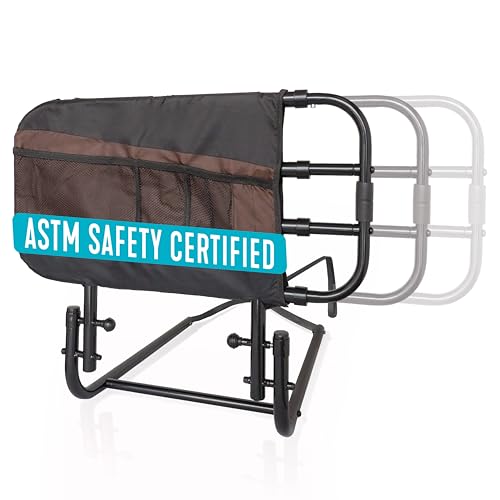
Stander EZ Adjust Bed Rail with Organizer Pouch
The only bed rail that adjusts in length (26-42 inches) after installation, letting you customize coverage for different needs.
Check Price on AmazonFalls from bed are a leading cause of injury in older adults, both in homes and in care facilities. Many of these falls happen at night during bathroom trips, when the person is groggy, the room is dark, and their muscles have stiffened from sleep. Others happen in the morning when blood pressure is low and legs have not yet warmed up.
A bed rail provides a handhold for these transitions. Something firm to grip while sitting up, something to push against while standing, and something to hold while lowering back into bed. The right rail makes the bed-to-standing transition safer, faster, and less painful for people with hip, knee, or back issues.
Types of Bed Rails
The term “bed rail” covers several different products with different purposes. Understanding the distinctions is important because choosing the wrong type for your situation can be ineffective or even unsafe.
Assist Rails (Half Rails)
Assist rails are the most common type for home use. They cover a portion of one side of the bed, typically 20 to 42 inches, and are designed specifically for the getting-in-and-out transition. They install between the mattress and the foundation and sit at roughly mattress height.
Assist rails are not intended to prevent someone from rolling out of bed. They provide a grab bar at the point where a person sits on the edge of the mattress and pushes to standing. For most seniors aging in place, an assist rail is the right choice.
Full-Length Bed Rails
Full-length rails run the entire length of the bed side and are primarily designed to prevent a person from falling out of bed during sleep. These are more common in care facilities and for people with conditions that cause significant movement during sleep, such as dementia with nighttime agitation.
Full-length rails have important safety considerations. They can create entrapment hazards if there are gaps between the rail, the mattress, and the bed frame where a person could become wedged. The FDA has issued multiple safety communications about entrapment risks with full-length bed rails. If you are considering full-length rails, ensure they meet current ASTM safety standards and that all gaps are properly addressed.
Bed Canes
A bed cane is a vertical post with a horizontal grab bar that mounts between the mattress and the foundation. It provides a single handhold point rather than a continuous rail surface. Bed canes are less obtrusive than rails and work well for people who need a grab point for standing but do not need the lateral support of a full rail.
Bed canes are also one of the few options that work with adjustable bed frames, since the post anchors at a single point rather than relying on a long base plate under the mattress.
Transfer Poles (Floor-to-Ceiling)
Transfer poles mount between the floor and ceiling using tension, providing a vertical grab bar that a person can hold while moving from bed to standing, from wheelchair to bed, or while repositioning. These provide the most support of any bed mobility aid because they are anchored at two structural points and can handle significant weight from any direction.
Transfer poles require a solid ceiling (not drop-tile) and a flat floor. They cost $100 to $200 and are the best option for someone with substantial weakness or who transfers from a wheelchair. However, they are a permanent fixture in the room and cannot be easily moved.
Rope Ladders
A rope ladder attaches to the foot of the bed and drapes across the mattress. A person lying flat on their back grips the rungs one at a time to pull themselves to a sitting position. This is a simple, inexpensive solution ($10 to $20) for people whose primary difficulty is the lying-to-sitting transition. It does not help with the sitting-to-standing transition, so it is often used in combination with a bed rail or cane.
Safety Standards to Look For
Bed rails are safety devices that bear significant loads. Not all rails on the market are tested to the same standards. When choosing a bed rail, look for these certifications.
ASTM F3186-17
This is the current voluntary safety standard for adult portable bed rails in the United States. It covers three critical areas: entrapment risk (gaps that could trap a person), structural integrity (whether the rail holds up under load), and stability (whether the rail stays securely attached to the bed). Rails that meet this standard have been tested against specific measurements for gap sizes and force tolerances.
FDA Oversight
The FDA classifies bed rails as Class II medical devices when they are marketed for medical purposes. Some bed rails sold as “furniture accessories” avoid this classification, which means they have not undergone the same scrutiny. If you are purchasing a bed rail for a senior with a medical condition that affects mobility, choose one that is either FDA-registered or ASTM-certified.
Weight Ratings
Bed rails specify a weight rating in pounds of force, not just body weight. A rail rated for 300 pounds of force can handle a 200-pound person pulling themselves up because the pulling force during the transition is less than the person’s total body weight. However, if someone falls against the rail with full body weight plus momentum, the forces are higher. Always choose a rail with a weight rating well above the user’s body weight to provide a safety margin.
Installation Best Practices
Proper installation is just as important as choosing the right rail. An improperly installed rail can shift, collapse, or create entrapment hazards.
Secure the Safety Strap
Most assist rails include a strap that wraps around the bed frame. This strap prevents the rail from tipping outward when someone pulls on it. The strap must be attached to a structural part of the frame, not a decorative side panel or a loose slat. Pull firmly on the installed rail from multiple angles to confirm it does not move.
Check Mattress Thickness
Every bed rail specifies a mattress thickness range. If your mattress is too thick, the base plate sits too close to the mattress surface and the rail may not have enough anchorage. If the mattress is too thin, the rail sits too high above the sleeping surface to be useful. Measure the mattress from the top of the foundation to the top of the mattress.
Eliminate Gaps
After installation, check for gaps between the rail and the mattress, between the rail and the headboard, and between the rail and the footboard. Any gap between 4.75 inches and 23.5 inches is in the danger zone for entrapment according to ASTM standards. Use foam bumpers, rolled towels, or pool noodles to fill gaps if they fall in this range.
Test Before First Use
Before the person uses the rail for the first time, test it yourself. Sit on the edge of the bed next to the rail. Grip it and pull yourself to standing. Push against it laterally. Try to rock it. It should feel completely solid. If there is any wobble, looseness, or shifting, tighten the strap or reposition the base plate before use.
Mattress and Bed Frame Compatibility
Not every bed rail works with every bed setup. Here are the common compatibility issues.
Adjustable Bed Frames
Most assist rails do not work with adjustable bed frames because the base plate sits under the mattress on top of the foundation, and adjustable beds do not have a flat foundation surface. When the bed articulates (raises the head or feet), the base plate shifts or pinches. For adjustable beds, use a bed cane that clamps directly to the frame, or a transfer pole that is independent of the bed entirely.
Platform Beds
Platform beds with a solid surface or closely spaced slats work well with most bed rails. The base plate sits on the platform, and the strap wraps around the frame. Platform beds with widely spaced slats may not provide enough support for the base plate. Check that the plate rests fully on slats without bridging a gap.
Mattress on the Floor
If the mattress sits directly on the floor with no frame or foundation, most bed rails will not work. There is no frame to strap to and no gap to slide the base plate into. A transfer pole (floor-to-ceiling) is the best option in this case, or raising the bed onto a low frame to enable rail installation.
Bunk Beds and Loft Beds
Standard assist rails are not designed for elevated beds. The base plate and strap system assumes a standard bed height. For elevated sleeping surfaces, use rails designed specifically for that application, with mounting hardware that attaches directly to the bed structure.
When Bed Rails Are Not Enough
Bed rails help with the transition between lying and standing, but they have limits. Here are situations where additional or alternative solutions may be needed.
Frequent falls from bed during sleep: An assist rail does not prevent rolling out. Consider a full-length rail (with proper entrapment safeguards), a lower bed frame, or placing a padded mat on the floor beside the bed.
Unable to sit up from lying flat: If the person cannot achieve a sitting position, a rope ladder, an adjustable bed frame that raises the head, or a bed wedge pillow may be needed before a rail is useful.
Cannot stand even with a handhold: If the person cannot push to standing even with a solid rail to grip, a transfer pole with a pivoting grab bar, a patient lift, or caregiver assistance may be required. The rail alone is not sufficient.
Cognitive impairment: For people with dementia who may not understand the rail’s purpose, a bed rail can become a climbing hazard rather than a safety device. In these cases, a very low bed (close to the floor) with a padded mat beside it may be safer than a rail that the person attempts to climb over.
The Bedroom Safety Checklist
A bed rail is one part of a safer bedroom. These additional steps complement the rail and further reduce fall risk.
Clear the path: Remove obstacles between the bed and the bathroom. Cords, throw rugs, shoes, and pet beds should not be in the walking path.
Add nighttime lighting: Motion-activated lights in the bedroom and hallway ensure the path to the bathroom is always visible. A night light beside the bed helps with the initial sit-up and stand-up transition.
Keep essentials within reach: Phone, glasses, water, and medications should be on a nightstand or in an organizer pouch attached to the rail. Every unnecessary trip out of bed is a fall risk.
Set the right bed height: The ideal bed height allows the person to sit on the edge with both feet flat on the floor and knees bent at approximately 90 degrees. If the bed is too high, use a shorter frame or remove the box spring. If too low, use bed risers. Correct bed height makes the rail more effective.
Consider a hospital-style setup: For someone with significant mobility limitations, a hospital-style bed with adjustable height, rails on both sides, and a trapeze bar above the head provides the most comprehensive support. Home hospital beds are available for rent or purchase and are covered by Medicare in many situations.
Choosing the Right Rail
For most seniors aging in place, an adjustable assist rail is the best choice. It provides a handhold for the most critical transition (bed to standing), adjusts as needs change, and installs in minutes without modifying the bed or room. Look for ASTM certification, a weight rating above the user’s body weight, and a design that folds down for bed-making.
If you are an adult child setting up a parent’s bedroom for safer aging in place, install the rail during a visit, test it together, and make sure your parent is comfortable using it before you leave. Show them how to grip it, how to push up, and how to fold it down if applicable. A bed rail that sits unused because it seems complicated is not providing any safety benefit. The five minutes you spend demonstrating the rail could prevent the fall that changes everything.