The Hidden Fall Risk in Everyday Tasks
Falls get most of the attention when they happen on stairs, in the bathroom, or during a walk. But a surprising number of senior falls happen during completely ordinary moments: picking up a dropped TV remote, reaching for a cereal box on the top shelf, bending to grab a sock from the floor, or leaning behind the couch to plug in a phone charger.
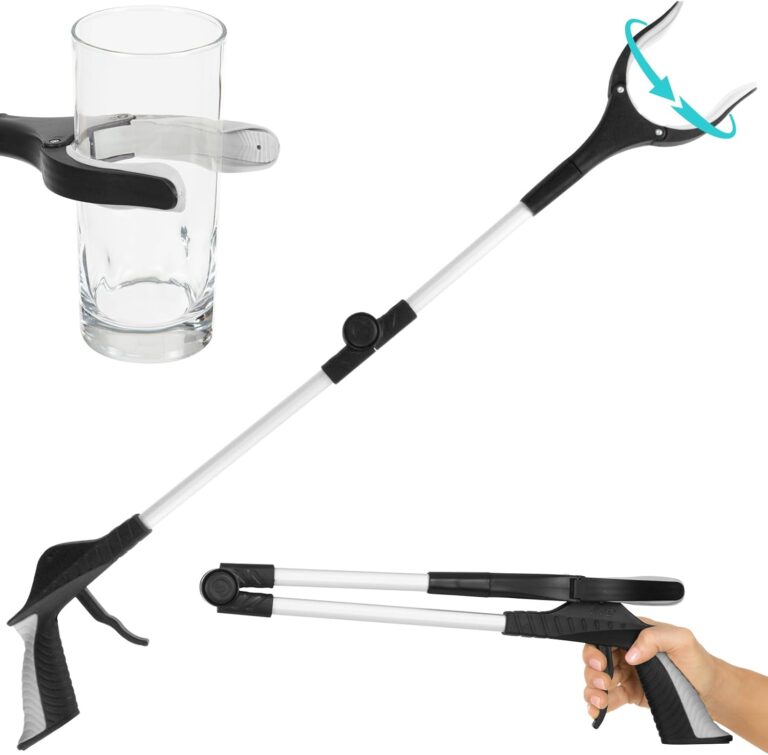
Vive 32″ Folding Grabber Reacher Tool with Rotating Jaw
Foldable design with 90-degree rotating jaw and sensitive trigger requiring minimal hand strength, ideal for arthritis.
Check Price on AmazonEach of these actions shifts your center of gravity away from your base of support. Bending forward moves your weight ahead of your feet. Reaching overhead tips you backward. Stretching to the side compromises your lateral balance. For younger people, the body corrects these shifts automatically. For seniors with reduced muscle strength, slower reflexes, or joint limitations, these corrections are slower and less reliable. The result is a loss of balance that happens in the kitchen, the living room, or the bedroom. Not on stairs. Not in the shower. Just while picking something up.
A reacher grabber eliminates these risky moments by extending your reach by 2 to 3 feet without requiring you to bend, stretch, or climb. It is one of the simplest and least expensive tools in the aging-in-place category, and it may be the one that prevents the most falls.
Types of Reacher Grabbers
All reachers work on the same basic principle: a long shaft with a trigger-operated jaw at one end and a handle at the other. But there are meaningful differences between types that affect who can use them and what they can do.
Standard (Non-Folding) Reachers
A rigid aluminum or plastic shaft, typically 26 to 36 inches long, with a fixed jaw and squeeze trigger. Standard reachers are the simplest and most durable option. With no folding mechanism or rotating parts, there is nothing to wear out or break. They cost $8 to $15.
The downside is portability. A 32-inch rigid stick does not fit in a bag, a nightstand drawer, or a walker pouch. You need to lean it against a wall or hang it from a hook, and it tends to slide and fall when propped up. Many people who start with a standard reacher end up upgrading to a folding model for convenience.
Folding Reachers
A folding reacher has a center hinge that lets it collapse to half its length. This makes storage and transport much easier. A 32-inch reacher folds to 16 inches, which fits in a tote bag, a large purse, a walker basket, or a nightstand drawer.
The hinge is a mechanical trade-off. It adds slight flex to the shaft under load, and it introduces a potential failure point over time. In practice, the flex is minimal for lightweight objects (which is what reachers are designed for), and modern locking hinges are durable enough for years of daily use. The convenience of folding outweighs the minor structural compromise for most users.
Rotating-Jaw Reachers
Some reachers have a jaw that rotates 90 degrees from horizontal to vertical. This is a significant advantage for tasks that require approaching an object from an angle: pulling a book off a shelf, reaching into a narrow space, or gripping an item that sits flush against a surface.
A non-rotating jaw works best when approaching objects from directly above or straight on. A rotating jaw handles these angles plus side approaches and tight spaces. For a reacher that will serve as an all-purpose daily tool, a rotating jaw is worth having.
Magnetic-Tip Reachers
Some reachers include a small magnet on the jaw tip. This helps pick up small metal objects like keys, paperclips, screws, or safety pins that the jaw cannot grip effectively. The magnet is a minor feature, but it is genuinely useful in the situations where you need it. Dropping a key on the floor and being unable to pick it up is both a fall risk and a lockout risk.
Heavy-Duty Reachers
Standard reachers lift up to about 5 pounds. Heavy-duty models use thicker shafts and reinforced jaws to handle up to 8 or 10 pounds. These are designed for people who need to grab heavier items like canned goods, books, or small appliances from shelves. The trade-off is weight: a heavy-duty reacher may weigh 12 to 16 ounces compared to 6 to 8 ounces for a standard model. For someone with limited arm strength, the heavier tool may cause fatigue.
Choosing the Right Length
Reachers come in lengths from 19 inches to 48 inches. The right length depends on how you will use it most.
19 to 24 inches: Best for use while seated in a wheelchair, recliner, or at a desk. Short enough to maneuver in tight spaces but long enough to reach the floor from a seated position.
26 to 32 inches: The most versatile range. Long enough to reach the floor while standing without bending, and to access standard-height shelves. This is the right length for most seniors as a general-purpose tool.
34 to 40 inches: For reaching higher shelves or for taller users who need extra length to reach the floor comfortably. Longer reachers are harder to control precisely and heavier, so only go longer if you actually need the extra reach.
42 to 48 inches: Specialized length for very high shelves or for picking up items from the ground while seated in a tall chair. At this length, the reacher is unwieldy for general use and is best reserved for specific tasks.
Features That Matter for Arthritis
Arthritis is the most common reason seniors struggle with reachers. The squeeze trigger that operates the jaw requires grip strength, and many reachers demand more force than arthritic hands can comfortably produce. Here is what to look for.
Trigger Sensitivity
The trigger should close the jaw fully with a light squeeze. Test this before buying if possible. A good trigger for arthritis will close the jaw with the force it takes to squeeze a stress ball, not the force needed to compress a tennis ball. Some reachers advertise “low force” or “arthritis-friendly” triggers. These claims are usually accurate.
Padded Grip
A rubberized or foam-padded handle reduces pressure on the palm and fingers. Hard plastic handles become uncomfortable after a few minutes of use for anyone, and they can be genuinely painful for arthritic hands. Padding is a standard feature on better reachers and worth insisting on.
Trigger Style
Most reachers use a pistol-style trigger operated by the index and middle fingers. Some use a full-hand squeeze grip where the entire hand closes around the handle. The full-hand style distributes force across more fingers and may be easier for people with significant finger weakness. However, pistol triggers generally offer more precise control.
Weight
A reacher that is too heavy to hold with one hand for more than a minute defeats its purpose. Standard reachers weigh 6 to 10 ounces. If arm strength is a concern, stay at the lighter end of this range. Folding reachers tend to weigh slightly more than rigid models because of the hinge hardware.
Common Household Uses
A reacher is not a niche tool that sits in a drawer for rare occasions. Once you start using one, you find applications everywhere. Here are the tasks that reacher owners use them for most often.
Picking up dropped items: The most common use. Pens, remotes, phones, socks, tissues, mail that slid off the counter. Instead of bending down (fall risk) or waiting for someone else to pick it up, the reacher handles it in seconds.
Getting dressed: Pulling socks up, positioning shoes for stepping into them, retrieving clothing from low drawers or the floor of a closet. For someone recovering from hip or knee surgery who cannot bend past 90 degrees, a reacher is essential for dressing independently.
Kitchen tasks: Reaching cans, boxes, and packages on high or low shelves. Retrieving items from the back of the pantry. Grabbing items from the countertop while seated at the kitchen table.
Laundry: Pulling clothes from the dryer (front-loading dryers require bending). Reaching into the bottom of a top-loading washer. Picking up dropped socks and small items from the laundry room floor.
Outdoor pickup: Retrieving the newspaper from the porch. Picking up sticks or debris from the yard without bending. Reaching through a car window to grab something from the back seat.
Behind and under furniture: Items that fall behind the couch, under the bed, or between the nightstand and the wall. These are spaces that require either moving heavy furniture or getting down on the floor. A reacher solves both problems.
One Reacher or Several?
Many reacher owners discover that one is not enough. Walking across the house to get the reacher every time you drop something defeats the purpose of convenience. A practical setup is to keep one reacher in each area where you spend significant time: the bedroom, the living room, and the kitchen.
At $10 to $15 each, buying three reachers costs less than a single co-pay at urgent care. Having one within arm’s reach whenever you need it eliminates the temptation to “just bend down this once” instead of walking to get the tool.
Hang reachers on hooks or store them in spots where they are visible and easy to grab. A reacher buried in a drawer will not get used. A reacher hanging on a hook by the kitchen counter will get used every day.
Care and Replacement
Reachers are simple tools with few parts that can fail, but they do wear over time.
Jaw tips: The rubber or silicone lining on the jaw tips wears smooth after months of daily use. When items start slipping from the grip, the tips have worn out. Some reachers have replaceable tips. For those that do not, replace the entire tool.
Trigger mechanism: The internal cable or linkage that connects the trigger to the jaw can stretch or fray after extended heavy use. If the jaw no longer closes fully when the trigger is squeezed, the mechanism has worn. This is a replacement situation, not a repair.
Folding hinge: On folding reachers, the hinge locking mechanism can loosen over time. If the reacher starts to fold or flex at the hinge during use, replace it. A folding hinge that gives way while holding an object at full extension could send the item falling unpredictably.
Cleaning: Wipe the jaws and handle with a damp cloth periodically. Kitchen reachers especially benefit from regular cleaning since they contact food packaging, sticky surfaces, and crumbs. Do not submerge the reacher in water, as moisture in the trigger mechanism can cause corrosion.
What a Reacher Cannot Do
Reachers are designed for lightweight daily tasks. Understanding their limits prevents frustration and unsafe use.
Most reachers cannot lift items over 5 pounds. Heavy cans, full gallon containers, books stacked together, and small appliances are beyond their capacity. Attempting to lift heavy items can break the jaw or cause the item to fall.
Reachers do not work well with very small, flat objects on smooth surfaces. A dime on a tile floor, a credit card on a table, or a flat piece of paper on a desk will slide away from the jaw rather than lift. Objects need some height for the jaw to grip around them.
Reachers are not designed for pulling force. Opening drawers, sliding heavy objects across a surface, or pulling doors closed are tasks that stress the jaw and trigger mechanism in ways they are not built to handle. Use the reacher for lifting, not dragging.
A Small Tool with a Big Impact
The reacher grabber does not look like important safety equipment. It looks like a toy or a novelty gadget. But for seniors who have lost the ability to comfortably bend, reach overhead, or get down to floor level, it is a daily necessity. It prevents the specific physical movements that cause a large number of household falls. It maintains independence by keeping everyday tasks manageable without help.
If you are an adult child visiting a parent and you notice them bending carefully to pick things up, using a step stool to reach shelves, or asking you to grab items from the floor, a reacher is the first tool to bring on your next visit. Three of them. One for the kitchen, one for the living room, one for the bedroom. At $15 each, it is $45 that could prevent a fall and the cascade of consequences that follows.