Your dad has the TV volume at 42. You can hear it from the driveway. At dinner, he asks you to repeat things three times and then pretends he understood. He insists his hearing is fine. You know it is not.
So you start researching solutions and immediately hit a wall of confusion. Hearing aids cost anywhere from $200 to $7,000. Personal sound amplifiers look identical but cost $30. TV listening devices promise to solve the volume problem for $100. An audiologist says he needs a full hearing evaluation first. Amazon says he can buy something today and have it tomorrow.
The truth is that these three categories of products serve very different purposes, and buying the wrong one wastes money and delays the right solution. This guide explains what each type does, who it is for, and how to figure out which one your parent actually needs.
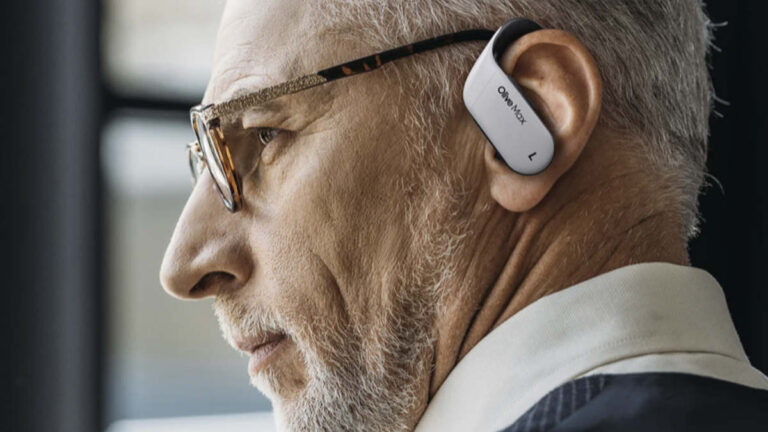
Olive Union Olive Max
AI-powered hearing amplifier that looks like modern earbuds with no prescription needed
Check Price on AmazonThe Three Categories, Explained Simply
Think of hearing loss like vision loss. If someone needs reading glasses, you do not hand them binoculars. If they need binoculars, reading glasses will not help. The tool has to match the problem. Hearing devices work the same way.
OTC Hearing Aids: For Diagnosed Hearing Loss
Over-the-counter hearing aids are FDA-regulated medical devices designed for adults with mild to moderate hearing loss. Since 2022, they have been available without a prescription in pharmacies and online. They are real hearing aids, not toys or gadgets. They amplify specific frequencies where the wearer has lost sensitivity, and many include sophisticated processing to reduce background noise, manage feedback, and adapt to different environments.
OTC hearing aids are the right choice when your parent has actual hearing loss. Not “sometimes has trouble hearing,” but a measurable reduction in hearing ability across specific frequencies. The typical pattern for age-related hearing loss (presbycusis) is difficulty hearing high-frequency sounds: consonants like S, F, TH, and SH. Words become mumbled because those consonant sounds are what distinguish “cat” from “cap” from “cash.” Vowels are lower-frequency and usually still audible, which is why your parent can tell someone is talking but cannot make out the words.
Price range: $200 to $1,500 per pair. The price difference reflects features like Bluetooth connectivity, rechargeable batteries, number of audio channels for fine-tuning, and the quality of noise reduction algorithms.
Who should buy these: Anyone who regularly struggles to understand speech in conversation, asks people to repeat themselves frequently, or has been told by a doctor that they have mild to moderate hearing loss.
Who should not: Someone with severe or profound hearing loss (OTC aids are not powerful enough), someone who only has trouble with TV volume (there is a cheaper, better solution), or someone who has not had their hearing evaluated at all (the first step is always an evaluation).
Personal Sound Amplifiers: For Situational Hearing Help
Personal sound amplifiers (PSAPs) look like hearing aids but are not classified as medical devices. They are not regulated by the FDA. They do one simple thing: make everything louder. They do not selectively amplify specific frequencies, they do not reduce background noise, and they do not adapt to different environments. They are a volume knob for your ears.
PSAPs are the right choice for people who have normal or near-normal hearing but want a boost in specific situations. Birdwatching. Attending a lecture in a large auditorium. Listening to a speaker at a religious service from the back row. These are situational needs, not medical ones.
Price range: $20 to $150 per pair.
Who should buy these: Someone with mostly normal hearing who wants amplification for occasional, specific situations.
Who should not: Anyone with actual hearing loss. PSAPs amplify all frequencies equally, which means they make background noise just as loud as speech. For someone with hearing loss, this makes understanding speech harder, not easier. The noise gets louder, but the words do not get clearer. This is the most common mistake families make: buying a $30 amplifier from Amazon thinking it will work like a hearing aid. It will not.
TV Listening Devices: For the TV Volume Problem
TV listening devices are a completely separate category. They do not go in your ear (usually). They do not help with conversation. They solve one specific problem: your parent needs the TV at volume 42 while everyone else in the room needs it at 18.
A TV listening device like the Serene TV SoundBox is a personal speaker that sits next to your parent’s chair or on their lap. It connects to the TV wirelessly and plays the audio at whatever volume your parent needs, while the TV itself stays at a normal volume for everyone else. Some models use headphones instead of a speaker, but many seniors dislike wearing headphones for long periods.
The speaker-style devices are often preferred because they are simpler. Your parent does not need to put anything on or in their ears. They do not need to charge headphones. They just sit in their chair and the speaker is right there. One remote controls the volume of the personal speaker independently of the TV volume.
Price range: $50 to $200.
Who should buy these: Anyone whose primary hearing complaint is TV volume. If your parent hears conversation reasonably well but blasts the television, a TV listening device is probably all they need. It is also a good complement to hearing aids. Many hearing aid users still prefer a TV listening device because hearing aids in a living room pick up all the room noise (the dishwasher, the dog, the air conditioner) along with the TV audio.
Who should not: Someone who cannot hear conversation, phone calls, or the doorbell. Those are signs of hearing loss that needs hearing aids, not a TV speaker.
How to Figure Out What Your Parent Needs
Before spending any money, observe your parent in different situations and ask a few questions. The answers will point clearly toward the right product category.
The TV Test
Is the TV volume the primary complaint? Sit with your parent during their favorite show. Note the volume level. Then mute the TV and have a conversation at normal speaking volume from about six feet away. If they can follow the conversation without difficulty but needed the TV at an unreasonable volume, a TV listening device is the right answer.
The Conversation Test
Have a conversation in a quiet room and then in a noisy environment (a restaurant, a family gathering, a room with the TV on). If they struggle in both situations, hearing loss is likely and hearing aids are the path. If they are fine in a quiet room but lost in noise, they probably have mild high-frequency hearing loss. OTC hearing aids with noise reduction will help the most.
The Phone Test
Can they follow a phone conversation without difficulty? Phone audio is already filtered and compressed, which actually makes it easier for people with mild hearing loss to understand. If they struggle on the phone, the hearing loss is likely moderate and beyond what a PSAP can address.
The Awareness Test
Can they hear the doorbell, the microwave beep, the smoke alarm, and the phone ringing from another room? If they are missing these environmental sounds, they have hearing loss that affects their safety, not just their comfort. This warrants hearing aids and possibly a formal audiological evaluation.
When to See an Audiologist
An audiologist is a hearing specialist who performs comprehensive hearing evaluations and recommends treatment. You do not technically need an audiologist to buy OTC hearing aids (that is the whole point of the OTC category). But an evaluation is valuable for several reasons.
Establishing a baseline. A hearing test creates a record of your parent’s current hearing levels across all frequencies. This baseline helps track whether hearing loss is stable or progressing over time.
Ruling out medical causes. Some hearing loss is caused by earwax buildup, ear infections, fluid behind the eardrum, or other treatable conditions. An audiologist can identify these and refer to an ENT doctor if needed. Buying a hearing aid for a problem that could be fixed by removing impacted earwax is a waste of money.
Severity assessment. OTC hearing aids are designed for mild to moderate hearing loss. If your parent’s loss is moderate-to-severe or severe, OTC aids will not be powerful enough. They will need prescription hearing aids that are professionally fitted and programmed. An audiologist determines where your parent falls on this spectrum.
Guidance on device selection. If an audiologist confirms mild to moderate loss, they can recommend specific OTC features that match the hearing profile. Someone who primarily loses high frequencies needs a different device than someone with flat loss across all frequencies.
Most hearing evaluations cost between $50 and $250 and may be covered by insurance. Medicare does not cover routine hearing tests, but many Medicare Advantage plans do. It is worth checking.
Price Comparison at a Glance
Here is a realistic breakdown of what you will spend in each category:
- TV listening device: $50 to $200 one-time cost. No ongoing fees. Solves the TV volume problem specifically.
- Personal sound amplifier: $20 to $150 one-time cost. No ongoing fees. Provides general amplification for occasional situations.
- OTC hearing aids: $200 to $1,500 one-time cost. Batteries or charging. Addresses mild to moderate hearing loss across all situations.
- Prescription hearing aids: $2,000 to $7,000 per pair. Includes professional fitting, programming, and follow-up adjustments. Required for moderate-to-severe or severe hearing loss.
- Audiological evaluation: $50 to $250 one-time. Provides the information needed to make a good decision.
The Combination Approach
Here is something the marketing rarely tells you: many people benefit from more than one device. A common and effective combination is OTC hearing aids for daily wear plus a TV listening device for evening television. The hearing aids handle conversation, phone calls, and environmental awareness. The TV speaker handles the specific challenge of television audio without blasting everyone else out of the room.
Another effective combination is OTC hearing aids paired with the accessibility features on a smartphone. Increasing the phone’s ringer volume, enabling captioned calls, and using Bluetooth to stream phone audio directly to the hearing aids creates a much better experience than hearing aids alone.
The Emotional Side of Hearing Loss
Here is the part that no product review covers. Hearing loss is not just a sensory problem. It is an isolation problem. Your parent may be withdrawing from conversations because they cannot follow them. They may stop going to church, to bridge club, to the senior center. They may feel embarrassed about asking people to repeat themselves. Depression and cognitive decline are both strongly correlated with untreated hearing loss.
When you approach the topic, lead with empathy, not technology. Do not say “You need a hearing aid.” Say “I noticed you seemed frustrated at dinner when everyone was talking. Would it help if we looked at some options together?” Frame it as a quality-of-life improvement, not a medical intervention. And be prepared for resistance. Many seniors associate hearing aids with being old, even if they are already old. The stigma is real, even if it is irrational.
OTC hearing aids have helped reduce this stigma somewhat. They look like earbuds. Nobody at the grocery store can tell the difference between a hearing aid and an AirPod. For a parent who resists the idea of a “hearing aid,” reframing the device as a “listening enhancer” or pointing out that it looks identical to the wireless earbuds their grandchild wears can sometimes break through the resistance.
Next Steps
Start by observing your parent in different listening situations. Use the tests above to narrow down whether the problem is TV-specific, conversation-specific, or across-the-board. Then choose the right category of solution. If there is any doubt about the severity of hearing loss, schedule an audiological evaluation before spending money on a device. The evaluation will tell you exactly what you are dealing with and point you toward the right solution with confidence.