Cooking is one of the last things people want to give up as they age. It is deeply connected to independence, routine, and identity. Telling a parent they can no longer cook feels like telling them they can no longer take care of themselves.
But the risks are real. Unattended cooking is the leading cause of home fires, and adults over 65 have the highest rate of cooking fire injuries. Memory lapses, slower reaction times, reduced sense of smell (meaning they cannot detect burning), and medications that cause drowsiness all compound the danger.
The good news: technology can preserve cooking independence while dramatically reducing fire risk. You do not have to choose between safety and autonomy.
The Real Danger: Unattended Cooking
Most kitchen fires do not start from dramatic events. They start from forgettable ones. A pot of water set to boil while someone goes to answer the phone. A burner turned on to preheat and then forgotten. A towel placed too close to an active burner.
For seniors with early memory issues, the pattern is especially dangerous. They may start heating something, walk to another room, and completely forget they were cooking. By the time the smoke alarm sounds (if it sounds, since many seniors disable or ignore them), the situation may already be serious.
The solution is not to remove the stove. It is to add a safety layer that monitors cooking activity and intervenes when things go wrong.
Automatic Stove Shutoff: How It Works
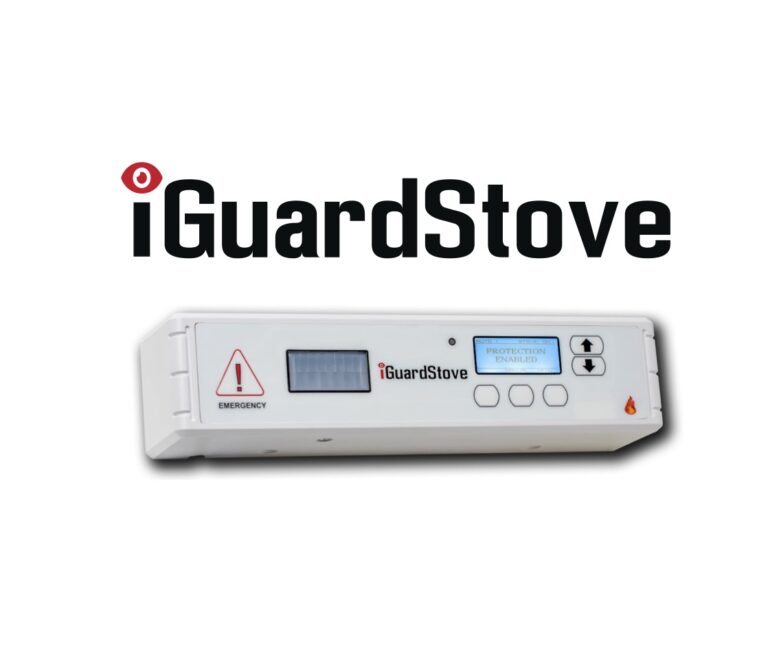
The iGuardStove is an automatic stove shutoff device that acts as a safety backstop. Here is the concept: a motion sensor monitors the kitchen. If it does not detect anyone in the cooking area for a set period (typically 5 minutes), it cuts power to the stove. If the cook returns, the stove reactivates automatically.
Think of it as a “dead man’s switch” for the kitchen. As long as someone is present and cooking, everything works normally. The moment the kitchen is unattended with the stove on, the system intervenes.
How installation works:
- Electric stoves: The iGuardStove plugs in between the stove and the wall outlet. The stove’s power cord plugs into the iGuardStove unit. No wiring changes, no electrician needed. Setup takes about 10 minutes.
- Gas stoves: Gas requires a different approach since you cannot simply cut electrical power. The iGuardStove gas version uses a motorized gas valve that shuts off the gas supply. This requires installation on the gas line, which should be done by a qualified technician.
The motion sensor: A small sensor mounts on the wall or ceiling in the kitchen, aimed at the stove area. It uses infrared detection (similar to a home security sensor) to determine if someone is present. The sensor connects wirelessly to the control unit.
Timer settings: You can adjust the unattended timer from 1 to 15 minutes. Five minutes is the recommended default. This gives enough time for a quick trip to the bathroom or to answer the door without triggering a shutoff, while still catching genuinely forgotten cooking.
Caregiver Alerts and Remote Monitoring
The iGuardStove sends notifications to designated caregivers when events occur:
- Stove turned on: Know when your parent starts cooking
- Auto shutoff triggered: The stove was left unattended and the system cut power
- Stove on for extended period: Cooking has been happening for longer than a set threshold
- Nighttime use: The stove was turned on during hours you have flagged as unusual (e.g., 11 PM to 5 AM)
You can also set “curfew hours” during which the stove simply will not turn on. This prevents dangerous confusion-driven cooking in the middle of the night, which is a real concern for people with moderate dementia or those on sleep medications that cause disorientation.
Voice-Controlled Kitchen Timers
One of the simplest and most effective kitchen safety tools is a voice-controlled timer. The Echo Show 8 sits on the kitchen counter and responds to voice commands. “Alexa, set a timer for 15 minutes” is far easier than fumbling with a stove timer or remembering to check the clock.
When the timer goes off, it sounds an alarm and displays a visual alert on the screen. For someone who might not hear a quiet oven timer from another room, the Echo Show’s speaker is loud enough to reach through the house.
Multiple timers: “Alexa, set a pasta timer for 10 minutes” and “Alexa, set an oven timer for 30 minutes” can run simultaneously with named labels, so there is no confusion about which timer is for what.
Step-by-step recipes: The Echo Show can display recipes with step-by-step instructions on screen. Your parent can say “Alexa, show me how to make chicken soup” and follow along without needing to handle a cookbook or a phone with wet hands.
Additional Kitchen Safety Measures
Smoke and Carbon Monoxide Detectors
This seems obvious but is often overlooked. Many seniors have old smoke detectors with dead batteries or have disconnected them because of false alarms from cooking. Replace all smoke detectors with 10-year sealed-battery models so there is no battery to change. Install one in the kitchen (use a photoelectric model, which is less prone to cooking false alarms) and one in every sleeping area.
Fire Extinguisher
Place a small kitchen fire extinguisher (ABC-rated) within arm’s reach of the stove. Mount it on the wall rather than under the sink where it might be forgotten. Better yet, keep a fire-suppression blanket on a hook near the stove. Blankets are easier to use than extinguishers and do not require the strength to pull a pin and squeeze a handle.
Kettle with Auto-Shutoff
If your parent frequently boils water for tea or coffee, replace any stovetop kettle with an electric kettle that has automatic shutoff and boil-dry protection. These kettles turn themselves off when the water boils and will not operate if empty. This eliminates one of the most common “left the stove on” scenarios.
Stove Knob Covers
For gas stoves, inexpensive knob covers ($10-15 for a set) prevent the burners from being accidentally turned on by bumping against the stove or by a confused person turning knobs without purpose. They snap over the existing knobs and require a deliberate push-and-turn to operate.
Having the Conversation
Introducing kitchen safety technology requires sensitivity. Nobody wants to hear “you are a fire risk.” Frame it around the technology being smart, not around the person being incapable.
Approaches that work:
- “I found this device that automatically turns off the stove if you step away. It is like a safety feature built into new cars. Everyone benefits from it.”
- “I set one up in my own kitchen too. It is great for anyone who gets distracted while cooking.”
- “This way you can keep cooking without any of us worrying. It is a win for everyone.”
Frequently Asked Questions
Will the iGuardStove interrupt normal cooking?
Not if someone is present. The motion sensor detects continuous presence in the kitchen. As long as your parent is standing at the stove, moving around the kitchen, or sitting at the kitchen table nearby, the stove stays on. The 5-minute default timer gives enough grace period for brief absences. If false shutoffs are a problem, you can extend the timer to 10 or 15 minutes.
Does it work with all stove types?
The electric version works with any standard 240V electric range that plugs into a wall outlet. The gas version works with most residential gas stoves but requires professional installation on the gas line. Induction cooktops and commercial-style ranges may require contacting iGuardStove for compatibility.
What if my parent turns the stove back on right after a shutoff?
The system reactivates when the person returns to the kitchen and turns the stove on again. It does not lock them out. It only intervenes when cooking is genuinely unattended. This preserves autonomy while preventing the dangerous scenario of an empty kitchen with an active burner.
My parent has a microwave. Is that safer than the stove?
Microwaves are generally much safer than stovetops because they have built-in timers and auto-shutoff. If your parent is primarily reheating food rather than cooking from scratch, encouraging microwave use is a practical safety measure. However, microwaves can still cause burns, and putting improper items inside (metal, certain plastics) is a risk for someone with cognitive impairment.