Sitting down on and standing up from the toilet are two of the most physically demanding motions in a senior’s daily routine. A standard toilet is only about 15 inches high, which forces the knees and hips into a deep bend that requires significant leg strength to reverse. For someone with arthritis, a recent hip or knee replacement, chronic back pain, or general age-related weakness, this simple daily task can become painful, exhausting, or downright frightening.
A raised toilet seat is one of the simplest, cheapest, and most effective solutions. By adding 2 to 6 inches of height to an existing toilet, it reduces the depth of the bend and the amount of effort required to sit and stand. Models with armrests add secure handholds that reduce strain even further.
This guide explains why toilet height matters so much, walks through the different types of raised seats available, and helps you choose the right one based on the user’s specific needs.
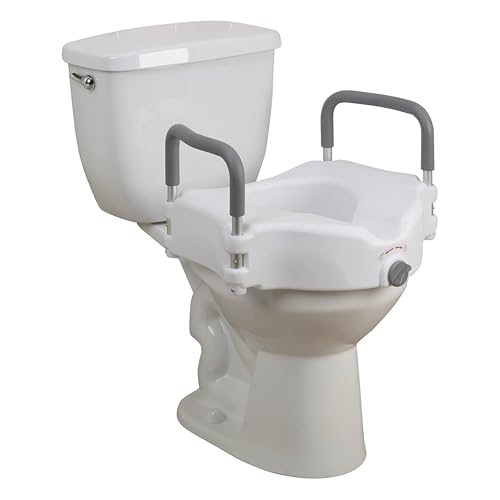
Drive Medical 2-in-1 Raised Toilet Seat with Removable Padded Arms
Adds 5 inches of height and includes removable padded armrests for safe sitting and standing from the toilet.
Check Price on AmazonWhy Toilet Height Matters
The physics of sitting and standing are straightforward. The lower the surface, the more your leg muscles have to work to lower you down and push you back up. At a 15-inch seat height, the hip and knee joints flex to roughly 100 to 110 degrees. This deep bend requires the quadriceps muscles to generate substantial force to reverse the motion.
For a healthy 30-year-old, this is effortless. For a 75-year-old with osteoarthritis in both knees, it can be the hardest physical task of the day. Many seniors compensate by dropping the last few inches rather than controlling the descent, which impacts the joints with considerable force. On the way up, they may push off the toilet paper holder, the wall, or the edge of the vanity, none of which are designed to support body weight.
After Hip or Knee Surgery
Orthopedic surgeons routinely prescribe raised toilet seats as part of post-surgical recovery. After a hip replacement, patients are typically told to avoid bending the hip past 90 degrees for several weeks. A standard 15-inch toilet makes this restriction nearly impossible to follow. A raised seat that brings the effective height to 19 or 20 inches keeps the hip angle within the safe range.
After a knee replacement, the issue is similar. The surgical knee needs to avoid excessive flexion during the early healing period. A higher toilet seat reduces the bend angle at the knee, making each bathroom visit safer and less painful during recovery.
Chronic Conditions
Beyond surgical recovery, many chronic conditions make low toilet seats problematic. Osteoarthritis, rheumatoid arthritis, spinal stenosis, Parkinson’s disease, and general sarcopenia (age-related muscle loss) all reduce the strength and flexibility needed for deep squatting motions. For people with these conditions, a raised toilet seat is not a temporary recovery aid. It is a long-term quality-of-life tool.
Types of Raised Toilet Seats
There are three main categories, each with different advantages and trade-offs.
Clamp-On Raised Seats (No Arms)
These are the simplest and most affordable option. A molded plastic seat clamps onto the existing toilet bowl, adding 2 to 5 inches of height. Most attach with a front-locking or rear-locking mechanism that tightens against the bowl.
Clamp-on seats without arms cost $15 to $40 and are available at any pharmacy or medical supply store. They are lightweight, easy to install, and easy to remove for cleaning or when guests visit.
The limitation is that there are no armrests. The user must rely on their own leg strength or nearby surfaces to sit and stand. For someone who only needs a few inches of extra height and has reasonable upper body strength, a basic clamp-on seat works fine. For someone with significant weakness, the lack of armrests may not provide enough assistance.
Raised Seats with Armrests
These combine the height boost of a clamp-on seat with padded armrests on both sides. The armrests provide secure handholds for lowering down and pushing up, reducing the load on the legs and adding a layer of stability.
This category is the most popular for seniors and post-surgical patients. The armrests transform the toilet from a balance challenge into a supported, controlled motion. Many users report that the armrests are actually more important than the added height, because having something to hold changes the entire experience from anxious to confident.
Prices range from $30 to $80. Most models attach with the same clamp mechanisms as armless seats, so installation is equally simple. The armrests typically detach without tools, allowing the seat to function as a basic riser when arms are not needed.
Toilet Safety Frames (Freestanding)
A toilet safety frame is a freestanding metal frame that surrounds the toilet and provides armrests without raising the seat height. Some models include a raised seat that attaches to the frame, combining both functions.
Frames are sturdier than seat-mounted armrests because they are supported by their own legs on the floor rather than being cantilevered from the toilet bowl. They typically have higher weight capacities (400 to 500 lbs) and feel more secure under heavy use.
The downside is that frames are larger and more visible. They look more like medical equipment, which some seniors find objectionable. They also require slightly more floor space and may not fit in very tight bathrooms. Prices range from $40 to $120.
Choosing the Right Height
The goal is to bring the toilet seat to a height where the user’s knees are at approximately 90 degrees when seated, with feet flat on the floor. This is the position that requires the least effort to sit down into and stand up from.
How to Determine the Right Height
Have the user sit on a standard dining chair, which is typically 17 to 18 inches high. If they can sit and stand from the dining chair comfortably, then a raised toilet seat that brings the toilet to a similar height is probably sufficient. For most people, this means adding 2 to 4 inches to a standard 15-inch toilet.
If the dining chair is also difficult, a higher boost may be needed. Seats that add 5 to 6 inches bring the toilet to 20 to 21 inches, which is higher than a standard chair and requires even less effort. However, very high seats can create a new problem: feet may not reach the floor firmly, which reduces stability. Do not add more height than necessary.
Standard Height Recommendations
2 inches added (17 inch total): Appropriate for mild difficulty, general comfort improvement, or prevention.
4 inches added (19 inch total): Appropriate for moderate difficulty, most post-surgical recovery, chronic joint pain.
5 to 6 inches added (20 to 21 inch total): Appropriate for significant weakness, severe arthritis, or users who need maximum assistance.
Installation Tips
Most raised toilet seats install in under five minutes without tools. Here are a few practical tips to ensure a secure, safe installation.
Check the Fit Before Relying on It
After installing the seat, press down firmly on the front, back, and each side. There should be no rocking, shifting, or lifting. If the seat moves, tighten the locking mechanism further or check that the seat is compatible with your toilet shape.
Round vs. Elongated Bowls
Toilets come in two shapes: round (about 16.5 inches from front to back of the bowl) and elongated (about 18.5 inches). Most raised toilet seats are designed for round bowls and will fit many elongated bowls as well, but the fit may not be perfect. Some manufacturers make specific elongated models for a flush, gap-free fit. Check the product description before ordering.
Seat-On-Seat vs. Seat-Replacement
Most raised seats place on top of the existing toilet seat. You do not need to remove the original seat. However, some models are designed to replace the existing seat entirely, bolting into the same hinge holes. Replacement-style seats provide a more integrated look and a more secure attachment, but they require a few minutes of installation with a wrench.
The Locking Mechanism
Front-locking seats use a single clamp or screw at the front of the bowl. This is the most common design and works well for most users. However, front-only locking can allow slight movement at the back of the seat. Rear-locking or bracket-locking designs are more stable but slightly more complex to install. For a heavy user or someone who shifts their weight frequently, a rear-locking or dual-locking model is worth the small extra effort.
Cleaning and Maintenance
Hygiene is the main ongoing consideration with a raised toilet seat.
Regular Cleaning
Wipe the seat with standard bathroom cleaner after each use or at least once daily. Most raised seats are smooth, non-porous plastic that does not absorb stains or bacteria. A quick wipe keeps them sanitary.
Deep Cleaning
Once a week, remove the raised seat entirely and clean both the raised seat and the original toilet underneath. Residue can accumulate in the gap between the raised seat and the original seat. This takes about five minutes: loosen the lock, lift the seat off, clean both surfaces, replace and retighten.
Armrest Care
If the seat has padded armrests, wipe the padding with a damp cloth and mild soap. Most armrest padding is not waterproof and should not be soaked. Some models have removable, washable armrest covers. If the padding starts to deteriorate, replacement armrest pads are available for most major brands.
When to Consider a Comfort-Height Toilet Instead
A comfort-height toilet (sometimes marketed as “right height” or “ADA-height”) has a built-in seat height of 17 to 19 inches, compared to the standard 15 inches. It solves the same problem as a raised toilet seat, but permanently and without any accessories.
Advantages of a Comfort-Height Toilet
There is nothing to install, remove, clean separately, or explain to visitors. The toilet looks like any other toilet. It is a permanent, maintenance-free solution.
Disadvantages
Replacing a toilet requires plumbing work. A new comfort-height toilet costs $150 to $400 for the fixture, plus $150 to $300 for professional installation. Total cost is typically $300 to $700, compared to $30 to $80 for a raised seat.
The height increase is also more modest. Comfort-height toilets top out at about 19 inches, while a raised seat on a standard toilet can reach 20 or 21 inches. For someone who needs maximum height, a raised seat may actually be the better option.
The Practical Path
For most people, the smart approach is to start with a raised toilet seat. It is cheap, instant, and reversible. If you use it for a few months and confirm that the added height genuinely helps, you can then decide whether to invest in a comfort-height toilet as a permanent upgrade. If the need is temporary (post-surgical recovery, for example), the raised seat may be all you ever need.
Talking to a Parent About Bathroom Aids
The bathroom is the most private room in the house, and bathroom aids carry a stigma that other safety equipment does not. A smoke detector is just sensible. A raised toilet seat feels like an admission that something has changed.
The most effective approach is matter-of-fact and practical. Rather than framing it as a safety intervention, frame it as a comfort upgrade. “I got one of these for our guest bathroom and it is way more comfortable. Want me to put one in yours?” is easier to accept than “I think you need this because you are having trouble in the bathroom.”
If a parent has recently had surgery, the conversation is even easier. The orthopedic surgeon almost certainly recommended a raised seat as part of recovery. In that context, the raised seat is medical equipment prescribed by a doctor, not an aging-related accessory chosen by a worried child.
Whatever the approach, the underlying reality is straightforward. A $39 raised toilet seat can extend independent bathroom use for months or years. It requires no modification to the home, no professional installation, and no ongoing cost. For the senior who has been quietly dreading every bathroom visit, it can be a meaningful daily improvement from the moment it is installed.