Falls in the bathroom account for a staggering share of senior injuries. The combination of wet surfaces, hard edges, small spaces, and the physical demands of bathing creates a perfect storm of risk factors. The Centers for Disease Control reports that more than 230,000 adults over 65 visit the emergency room each year due to bathroom falls, and the shower or bathtub is the most common spot where these falls happen.
The good news is that bathroom falls are highly preventable. Most can be avoided with a few targeted changes that cost very little and require no major renovation. A shower chair, a few grab bars, and some non-slip accessories can reduce the risk dramatically.
This guide covers everything you need to know about making showers safer for an older adult, whether you are a senior thinking about your own safety or an adult child looking out for a parent.
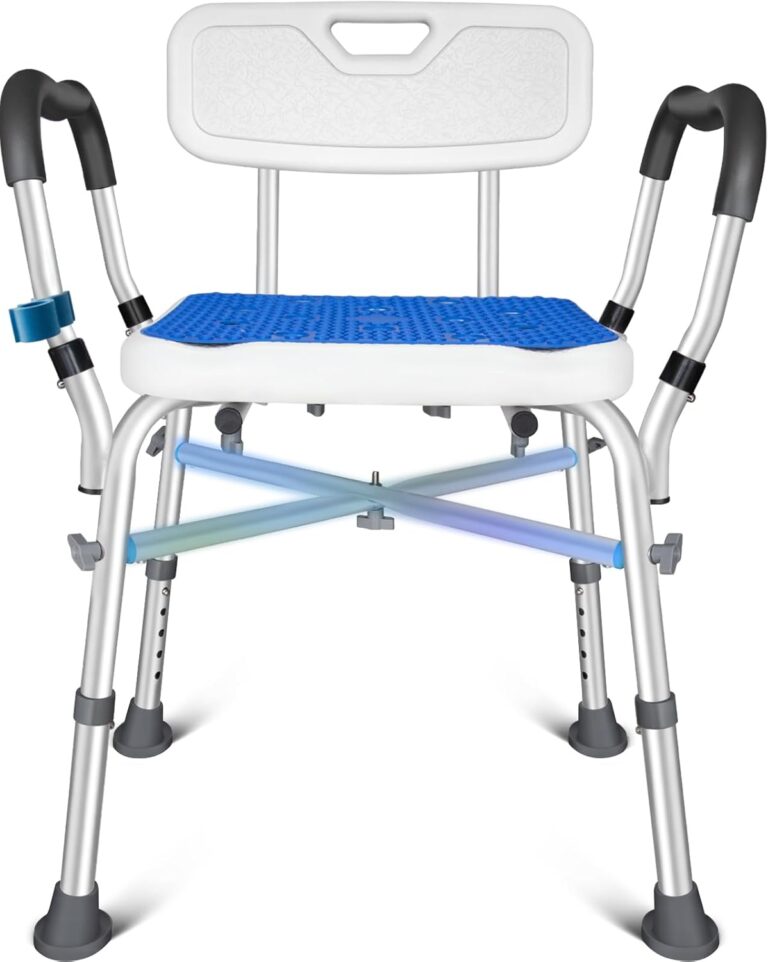
KingPavonini Shower Chair, 550 LB Heavy Duty with Arms and Back
Reinforced aluminum frame with crossing bar supports up to 550 lbs while weighing only about 7 lbs, making it easy to move.
Check Price on AmazonWhy Showers Are So Dangerous
Showering combines almost every risk factor for falls into a single activity. Understanding why showers are dangerous helps explain why specific interventions work.
Wet, Slippery Surfaces
Water plus soap residue creates an extremely slippery surface. Tub floors, tile, and porcelain all become friction-free when wet. A person standing in a tub has very little grip, and even a small shift in weight can cause a foot to slide.
Balance Challenges
Showering requires standing on one surface while performing tasks that challenge balance: reaching overhead to wash hair, bending to wash legs and feet, turning to rinse the back, tilting the head back to keep water out of the eyes. Each of these movements shifts the center of gravity and requires balance adjustments that become harder with age.
Vision Impairment
Water in the eyes, steam fogging glasses (for those who wear them in the shower), and the general humidity all reduce visibility. Many seniors close their eyes during portions of the shower, eliminating visual input entirely. Without visual reference points, balance relies entirely on the inner ear and proprioception, both of which decline with age.
Temperature Effects
Hot water causes blood vessels to dilate, which can lower blood pressure. For seniors who already take blood pressure medication, this effect can cause lightheadedness or dizziness during or immediately after a shower. Standing up quickly in a hot shower is a common trigger for a sudden drop in blood pressure.
Stepping In and Out
The act of stepping over a tub wall is one of the highest-risk moments. It requires standing on one leg while lifting the other over a barrier that is typically 14 to 18 inches high. Loss of balance during this maneuver can result in a fall onto the hard edge of the tub, which is one of the most injury-prone fall scenarios.
Types of Shower Seating
Sitting down eliminates the balance challenge almost entirely. The question is which type of shower seating fits the user’s bathroom and needs.
Shower Chairs
A shower chair is a freestanding seat with four legs, a backrest, and usually armrests. It sits inside the tub or shower stall and provides a stable, elevated seat. The user can shower while seated, eliminating the need to stand on a slippery surface.
Shower chairs are the most versatile option. They are portable, require no installation, and can be moved in and out of the bathroom as needed. Quality models have adjustable legs, non-slip feet, and weight capacities of 300 to 550 lbs. Prices range from about $40 to $150 depending on features and build quality.
Shower Stools
A shower stool is a simpler version of a shower chair without a backrest or armrests. Stools work well for people who have good upper body balance and just need to take the weight off their legs during a shower. They are smaller, lighter, and easier to store.
The downside is that there is nothing to lean against or grab onto. For someone with significant balance issues, a stool alone may not provide enough security. Pairing a stool with wall-mounted grab bars can compensate for the lack of armrests.
Transfer Benches
A transfer bench extends across the full width of the tub, with two legs inside the tub and two legs outside. The user sits on the bench from outside the tub, then slides across to the inside. This completely eliminates the need to step over the tub wall, which is the highest-risk moment of bathing.
Transfer benches are the best option for anyone who has difficulty stepping over the tub rim. They are especially valuable after hip surgery, for people who use walkers, or for anyone who has experienced a previous fall while getting in or out of the tub. They cost $50 to $200 and require no permanent installation.
Wall-Mounted Fold-Down Seats
A fold-down seat mounts permanently to the shower wall and folds flat against the wall when not in use. These are common in accessible hotel rooms and ADA-compliant bathrooms. They provide a clean, permanent seating solution that does not take up floor space.
The installation requires drilling into wall studs or using heavy-duty wall anchors. This is a job for a handy family member or a handyman. The seat must be anchored to structural framing, not just drywall, to safely support body weight. Once installed, a wall-mounted seat is the most elegant and space-efficient option.
Choosing the Right Shower Seating
The right choice depends on the user’s specific situation. Here is a quick decision framework.
Good balance, just wants to rest legs: A shower stool with wall-mounted grab bars.
Moderate balance issues, can step into tub: A shower chair with backrest and armrests.
Cannot safely step over the tub wall: A transfer bench that spans the tub.
Permanent solution, walk-in shower: A wall-mounted fold-down seat with grab bars.
Grab Bars: The Essential Companion
A shower seat handles the sitting portion of bathing. Grab bars handle everything else: getting in, getting out, standing up from the seat, and steadying yourself during transitions.
Where to Install Grab Bars
The three most important locations are:
Entry point. A vertical or angled bar on the wall near where the user steps into the tub or shower. This provides a handhold during the highest-risk moment.
Inside the shower at seated height. A horizontal bar at about 33 to 36 inches from the floor, within reach while seated on the shower chair. This helps with balance while washing and provides support when standing up from the seat.
Near the showerhead. A vertical bar near the shower controls gives the user something to hold while adjusting water temperature or reaching for soap.
Grab Bar Installation
Grab bars must be anchored into wall studs or blocking. Suction-cup grab bars are sold as a no-drill alternative, but most safety experts advise against relying on them. Suction cups can fail without warning, especially on textured tile or over time as the suction weakens. A stud-mounted grab bar rated for 250 lbs or more is the only safe option for someone who may be putting their full weight on it during a fall.
Installation typically requires a drill, a stud finder, and basic hardware skills. Many home improvement stores offer installation services, and some Area Agencies on Aging provide free or low-cost grab bar installation for qualifying seniors.
Non-Slip Accessories
Tub Mats
A non-slip mat inside the tub or shower floor provides additional traction underfoot. Look for mats with suction cups on the bottom (to keep the mat in place) and a textured rubber or PVC surface on top (to grip feet). Replace mats when the suction cups start to weaken or the surface texture wears smooth.
Adhesive Tread Strips
Adhesive tread strips stick directly to the tub floor in parallel lines. They provide traction without covering the entire surface. These work well in tubs where a full mat does not lie flat, and they are nearly invisible. They do need to be replaced periodically as the adhesive loosens from water exposure.
Bath Mats Outside the Tub
The floor immediately outside the tub is another danger zone. A thick, absorbent bath mat with a non-slip rubber backing absorbs water and provides traction for wet feet stepping out of the tub. Make sure the mat lies flat without curled edges that could cause tripping.
Handheld Showerheads
A handheld showerhead on a flexible hose is a simple upgrade that makes seated showering far more practical. With a fixed overhead showerhead, a seated person cannot easily direct water where it needs to go. A handheld unit lets the user rinse everywhere while staying seated and stable.
Handheld showerheads install by simply unscrewing the existing showerhead and screwing on the new one. No plumber needed. Most models include a wall-mount bracket so the handheld can be used in a fixed position or removed as needed. Look for a model with a long hose (at least 60 inches) and an easy-to-use on/off button or pause feature.
When to Consider a Bathroom Renovation
For some situations, accessories and equipment are not enough. If any of the following apply, a more significant bathroom modification may be worth exploring.
The tub wall is too high to step over safely, even with a transfer bench. A walk-in shower with a low or zero-threshold entry eliminates the step-over entirely.
The bathroom is too small for a shower chair or transfer bench. A custom walk-in shower can be designed to fit the space with built-in seating.
The user is a full-time wheelchair user. A roll-in shower with a zero-threshold entry and a fold-down seat provides wheelchair-accessible bathing.
Multiple fall-risk factors are present. If the user has significant balance problems, vision impairment, and cognitive decline, a comprehensive bathroom redesign with professional input may be safer than a collection of individual accessories.
Bathroom renovations for accessibility typically cost $3,000 to $15,000 depending on scope. Some state and local programs offer grants or low-interest loans for aging-in-place modifications. Contact your local Area Agency on Aging for information about programs available in your area.
A Conversation About Bathroom Safety
If you are an adult child reading this, you may already suspect that your parent’s bathroom is not as safe as it should be. Maybe you noticed them gripping the towel bar (which is not designed to support body weight) when stepping out of the tub. Maybe they mentioned feeling dizzy after a hot shower. Maybe they just seem to be showering less often, which is sometimes a sign that they are avoiding the tub because they are afraid of falling.
The bathroom safety conversation does not have to be difficult. Start with a specific, practical offer. “I picked up a shower chair and a grab bar. Can I install them this weekend?” is much easier to accept than “We need to talk about your safety.” Most seniors are well aware of the risk. They just have not gotten around to doing anything about it, or they do not want to make a fuss.
A $76 shower chair, a $30 grab bar, and 30 minutes of installation can prevent a fall that leads to a hip fracture, a hospital stay, and months of rehabilitation. The math is simple. The best time to make these changes is before they are urgently needed.